

Market Analysis
FIFA World Cup 2026 Economic Impact: What Happened and What Investors Can Learn
The 2026 World Cup is over. Review record attendance, pre-tournament economic projections, host-city demand, and the investor lessons that remain after the final.

- By
- Anil Lacoste
- Published
- Last updated
- Reading time
- 11 min read
Key takeaways
- FIFA reported a record 6,810,966 spectators across the 104-match tournament.
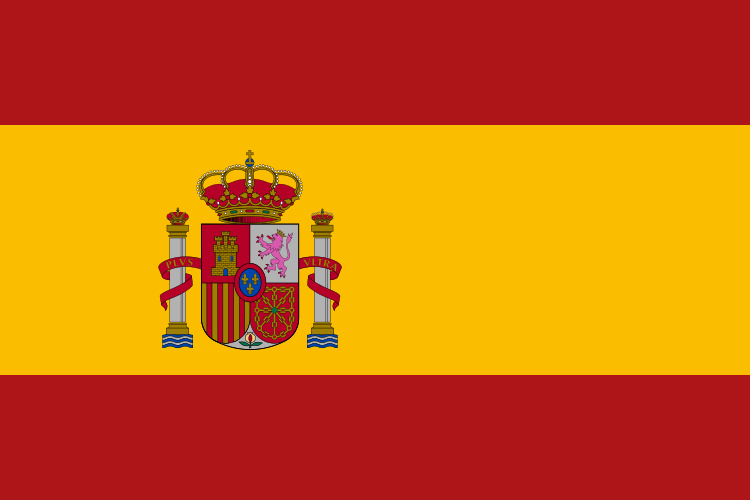
- Spain beat Argentina 1-0 after extra time in the July 19 final.
- The widely cited $41B global and CAD $3.8B Canada figures were pre-event projections, not final realized-impact measurements.
- The clearest economic effects were concentrated in host-city travel, hospitality, payments, media, and event spending.
- For investors, actual revenue exposure and valuation matter more than event hype.
The FIFA World Cup 2026 ended on July 19 with Spain beating Argentina 1-0 after extra time in New York/New Jersey. FIFA reported a record 6,810,966 spectators across the first 48-team, 104-match World Cup.
That changes how this article should be read. Before the tournament, estimates such as $41 billion of global economic impact and roughly CAD $3.8 billion of projected benefits for Canada were forecasts. They should not be presented as if all of that activity has already been independently measured and confirmed.
The more useful post-event question is what we can observe now: record attendance, heavy travel and hospitality demand, major sponsor and media exposure, and concentrated activity in host cities. Full realized economic-impact studies will take longer to publish.
This article now separates pre-event projections from observed tournament activity and focuses on the lessons investors can carry forward.
What actually happened
- FIFA reported 6.81 million total match spectators, a tournament record.
- Spain won the final against Argentina on July 19, 2026.
- FIFA Fan Festivals extended attendance beyond stadiums, including very large crowds in host cities.
- The tournament clearly generated major travel, hospitality, payment, media, security, and event activity, but those observations are not the same thing as a final GDP-impact study.
- The best investment lesson remains the same: focus on companies and assets with measurable revenue exposure rather than assuming a large sporting event automatically creates attractive returns.
Sources: FIFA tournament final recap and FIFA Fan Festival recap.
Why the timing matters for Canada
The United States, Canada, and Mexico co-hosted the biggest World Cup in history at a fragile moment for the Canadian economy. The timing is unusual because the Canadian economy has been dealing with weak business investment, inflation pressure, high household debt, and uncertainty around trade and energy costs.
A technical recession usually means two consecutive quarters of annualized GDP decline. That sounds severe, but the details matter. In this case, Canadian households continued to spend on essentials and services even while companies delayed capital investment. That makes the recession different from a broad consumer collapse.
The World Cup entered this environment as a concentrated demand shock. Fans travel, hotels fill, bars and restaurants become busier, merchandise sales rise, airports get more traffic, and host cities receive global media attention. The impact is not evenly distributed across the whole economy. It is concentrated in the places and sectors connected to the tournament.
That is why the FIFA World Cup 2026 market story is not a general bet on the entire Canadian economy. It is a focused question: which cities, companies, and sectors receive measurable demand from the tournament?
What previous World Cups teach investors
Large sporting events often come with huge headline numbers. Those numbers can be misleading if they are treated as national economic miracles. At the macro level, even a major event can be small compared with the size of a large economy.
The better lesson comes from looking at specific markets.
Brazil 2014 is the clearest example. In the years leading up to the tournament, property prices rose sharply in major host cities. São Paulo home prices increased by about 25 percent from 2010 to 2013. In Rio de Janeiro, property values rose by about 28 percent during the same period, especially in areas close to Maracanã Stadium. Investors who acted early had a much better outcome than people who noticed the trend only when the tournament started.
Qatar 2022 showed a different pattern. Tourism increased meaningfully after the tournament. Retail and commercial property benefited from stronger visitor traffic and consumer spending. Even under strict alcohol rules around venues, AB InBev reported stronger beer sales during the match period.
The message is simple. World Cup economics are often local and sector-specific. National GDP numbers can look modest, while certain neighborhoods, companies, and industries experience a much stronger effect.
Canada’s World Cup 2026 economic impact
Before the tournament, Canada’s projected benefit was estimated at about CAD $3.8 billion. That includes roughly CAD $2 billion in GDP contribution, CAD $1.3 billion in wages, and the creation or retention of more than 24,000 jobs.
Toronto and Vancouver are the Canadian host cities. Each match is expected to generate a meaningful local uplift through hotels, restaurants, transportation, tourism, event staffing, security, retail, and entertainment. For cities already facing affordability pressure, the opportunity is positive but complicated.
The positive side is clear. Tourism and event-driven spending can support jobs and business revenue. Local hospitality workers, restaurants, short-term rental operators, transportation providers, and event suppliers may benefit directly.
The difficult side is also real. When demand rises quickly in a city with tight housing and high living costs, prices can rise further. That can help property owners and investors, but it can also pressure renters and local consumers. This is why the World Cup 2026 host city real estate story should be viewed with both opportunity and caution.
Canada recession 2026: why the consumer still matters
Canadian consumers are under pressure. Food and housing prices have risen significantly since 2020, and household debt levels remain high. A larger share of disposable income is being used for interest payments, leaving less room for discretionary spending.
Still, event spending behaves differently from normal spending. People who cut back on daily purchases may still spend on once-in-a-generation experiences. The World Cup can trigger spending on meals, local travel, sports merchandise, viewing parties, hotels, and entertainment.
For investors and business owners, the important point is not that all consumer spending will boom. The important point is that spending can shift toward specific categories for a short period. Bars, restaurants, hotels, airlines, payment networks, broadcasters, and official sponsors can receive a temporary but powerful demand boost.
For households, the smarter approach is to separate excitement from financial discipline. Enjoying the tournament is reasonable. Overpaying for assets only because of hype is risky.
Before making a major purchase or investment decision, it can help to calculate how inflation has affected your real purchasing power. The FomoDejavu Inflation Calculator can help you compare today’s money with earlier purchasing power.
Market theme 1: host city real estate
Real estate in host cities is one of the most visible World Cup investment themes. The reason is straightforward. Major events can accelerate infrastructure upgrades, increase global attention, raise short-term rental demand, and improve the long-term profile of a city.
Toronto and Vancouver already have expensive property markets, so the opportunity may not be as simple as buying any property and expecting easy gains. The better question is whether specific neighborhoods, short-term rental zones, commercial corridors, and transit-connected areas receive stronger demand from the tournament.
In the United States, cities such as Dallas, Atlanta, Kansas City, Philadelphia, Miami, and Los Angeles may see similar effects. Secondary host cities can sometimes offer a more interesting risk-reward profile because global visibility and infrastructure investment may create a larger relative change.
Readers should avoid treating this as a guaranteed return. The better approach is to model cash flow, vacancy risk, local rental rules, mortgage costs, tax treatment, and post-event demand. The FomoDejavu Real Estate section can help stress-test historical property scenarios before making a decision.
Market theme 2: media and advertising
Media rights are one of the least speculative parts of the World Cup financial story. Broadcasters with rights to tournament matches can sell advertising around guaranteed global attention.
Fox Corporation has English-language broadcast rights in the United States for all 104 matches. As an educational example, the tournament offers a large advertising window across group-stage matches, knockout rounds, and the final. Advertising demand usually becomes strongest when matches involve popular teams, close elimination games, or prime-time viewing slots.
The key difference between media rights and general market sentiment is contractual visibility. Broadcasters know the match schedule, inventory, and audience potential. That makes advertising revenue easier to study than general consumer enthusiasm.
Market theme 3: beverages, consumer staples, and official sponsors
Official sponsors and companies with tournament contracts may have a clearer path to revenue than companies relying only on a general tourism lift.
AB InBev is a useful historical example because it has held official beer-related rights connected to FIFA events. Previous tournaments showed that beer consumption can rise significantly during match periods, even when local restrictions limit sales near venues.
Coca-Cola and Adidas also illustrate how global sponsorship visibility, merchandise demand, and brand association can matter. These companies are not pure World Cup plays because they are large global businesses with many revenue drivers. However, the tournament can still act as a near-term case study in sponsor exposure.
The practical research question is whether any expected World Cup boost is already reflected in market prices. Companies with strong contracts are easier to analyze than companies that simply hope fans will spend more.
Market theme 4: payments and cross-border transactions
The FIFA World Cup 2026 was hosted across three countries, creating a major travel and payments story.
Record tournament attendance translated into millions of fan journeys between cities, hotels, airports, restaurants, stadiums, and retail locations. Cross-border card transactions can rise as international visitors pay for lodging, food, transport, souvenirs, and experiences.
Visa is one example of a payment network tied to transaction volume rather than only to one category of spending. The more fans move across borders and host cities, the more payment networks can benefit from everyday purchases.
This makes payments one of the cleaner World Cup 2026 business themes to study. It is less dependent on one hotel chain or one city. It is linked to the broader movement of people and money throughout the tournament.
Market theme 5: hotels, restaurants, and hospitality
Hotels, restaurants, and hospitality companies are obvious beneficiaries, but operating benefits do not automatically translate into attractive investment returns after the story becomes obvious.
Hotel stocks such as Marriott and Hilton can benefit from higher occupancy and stronger average daily rates. Restaurants near host cities may see increased matchday traffic. Local bars and entertainment venues can also receive a major boost from fans watching games together.
The risk is valuation. If investors have already priced in the World Cup effect, future returns may depend on bookings exceeding expectations. Softer booking data can hurt stocks even when the tournament still brings more customers than normal.
For this reason, readers should distinguish between real demand and market expectations. A company can benefit operationally while still being a poor investment if its share price already assumes a perfect outcome.
Market theme 6: sports betting and prediction markets
Sports betting and gaming may be among the highest-growth World Cup 2026 themes. A 39-day tournament with daily matches creates constant engagement.
DraftKings, Flutter and FanDuel, Bet365, Robinhood prediction markets, and other platforms are examples of businesses that may see increased activity around match outcomes, player performance, futures markets, and live betting. The potential activity is large because football is a global sport with extremely high engagement.
The risk is regulation. Sports betting laws vary by jurisdiction, and investors should understand the rules in each market. Marketing costs can also rise as platforms compete for users during major events.
This is a higher-risk, higher-volatility theme compared with payments or consumer staples.
What Goldman Sachs gets right and what investors should add
A cautious macro view is reasonable. The World Cup may be meaningful for certain industries but still small compared with the total GDP of the United States or Canada. That does not make the investment theme irrelevant.
Most retail investors do not study only the entire economy. They compare sectors, stocks, property markets, and themes. At that level, the World Cup can matter.
The right framework is not “Will the World Cup save Canada from recession?” The better question is “Which businesses and assets receive direct demand because of the World Cup?”
That question leads to a more useful investment map: host city real estate, media rights, official sponsors, beverages, payment networks, hospitality, and sports betting.
Risks investors should not ignore
World Cup 2026 market themes come with real risks.
First, the event is temporary. Some revenue may disappear quickly after the final match. Second, valuation matters. A good company can be a poor investment if the stock price already reflects the benefit. Third, real estate investors must consider mortgage rates, local rules, taxes, insurance, and post-event demand. Fourth, Canadian households are still facing high costs for essentials, so discretionary spending is not unlimited.
Investors should also avoid confusing headlines with evidence. A $41 billion global economic impact does not mean every related stock will rise. It means the event creates a large pool of activity, and investors must identify where that activity becomes revenue, cash flow, or durable asset value.
Bottom line
The FIFA World Cup 2026 is no longer a forecast. The tournament delivered record attendance and an enormous concentration of travel, hospitality, media, payments, and event activity across North America.
What is not yet available is a single final, independently verified number proving that every pre-event economic-impact estimate was realized. The $41 billion global figure and Canada’s CAD $3.8 billion estimate should therefore remain labeled as projections until post-event studies quantify the realized effect.
For investors, the durable lesson is more useful than the headline number. Direct contractual exposure, actual revenue growth, cash flow, and valuation matter more than excitement around the event. The next time a global event creates a similar narrative, separate the forecast from the measurable business result.
FAQ: FIFA World Cup 2026 economic impact and market context
What is the estimated economic impact of the FIFA World Cup 2026?
Pre-event studies estimated about $41 billion of global economic impact and roughly CAD $3.8 billion of benefits for Canada. Those are projections; final realized-impact studies should be used once they are available.
Can the World Cup help Canada recover from recession?
The World Cup was too concentrated and temporary to be treated as a national recession cure. Its clearest effects were local, especially in host-city hospitality, tourism, restaurants, transportation, payments, and event services.
Which World Cup 2026 business themes are worth studying?
Readers may study companies with contractual or direct exposure, including media rights holders, official sponsors, beverage companies, payment networks, hospitality companies, and sports betting platforms.
Is host city real estate a good World Cup 2026 investment?
It can be, but only when the numbers work. Investors should analyze local rules, mortgage costs, rental demand, taxes, vacancy risk, and whether post-event demand is likely to remain strong.
What is the biggest mistake retail investors make with World Cup investments?
The biggest mistake is chasing sentiment after the opportunity has already been priced in. The better strategy is to look for direct revenue exposure, specific city demand, and realistic valuation.

About the author
Anil Lacoste
Wealth Management Advisor
Anil provides expert financial guidance focused on personalized investment strategies, risk management, and comprehensive wealth planning.
Background
Anil Lacoste is a dedicated Wealth Management Advisor at TD based in Toronto, Ontario. He specializes in helping clients navigate complex financial landscapes by building tailored portfolios that prioritize long-term stability and growth. With a deep understanding of the Canadian and global markets, Anil’s approach is rooted in providing actionable, high-level advice that empowers individuals to meet their specific financial milestones. Whether it’s retirement security, tax-efficient investing, or estate planning, Anil’s expertise ensures that his clients' wealth is managed with precision and foresight. His commitment to transparency and professional integrity helps bridge the gap between financial goals and real-world results, always grounded in the trusted methodology and resources of TD.
Methodology note
Figures are educational estimates based on historical market data and stated assumptions. They do not include every real-world variable (taxes, slippage, fees, behavior, or account constraints). Re-run the scenario with your own inputs before making decisions.
Related articles
Related tool
Backtest this idea with the investment calculatorMove from theory to measurable historical outcomes.